Recover your ad spend faster
Paid traffic is too expensive to waste on generic email marketing.
You’ve spent money getting people to your store.
Stop letting that attention go to waste.


You’re paying twice for the same customer
Most of the traffic you’re paying for leaves without buying. Email was supposed to bring them back.
A senior person talks a good game on a sales call, then the work turns into cookie-cutter flows and emails that sound like everything else in the inbox. Nobody opens them, nobody comes back, and you go spend money on the same traffic again.
If this sounds familiar, your email needs to get closer to the customer:
- Not email automations for the sake of it
- Not a campaign calendar that needs filling
- Not guesswork dressed up as strategy
Email marketing works when it understands what customers need to hear, where they came from, what they already believe, what’s stopping them from buying, and, most importantly: built around what a repeat customer is actually worth to you.
Generic email marketing is expensive
If your store is doing 100k a month and email is still a small slice of revenue, you’re likely leaving 5 figures on the table every month. And that gets expensive fast.
Even worse, someone who does not understand deliverability can burn through a list you spent years (and money!) building. Destroying the sender reputation of your domain is not something you want to deal with.
Bad email marketing can be covered up with the easiest fix: yet another discount. And that quietly chips away at your brand prestige and margin with every. single. send.
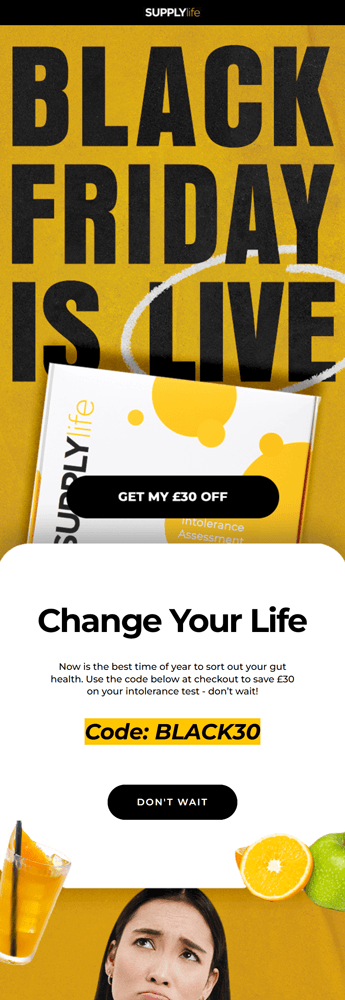
£1 million extra revenue for the UK’s top-rated food intolerance test kit
“Email revenue grew from 10% to 28%, which brought in over £1m a year. It gave us the ability to be so much more ambitious with our Google & Meta ads”
Co-owner @ Supply Life, Director @ West Ham United
Great to work with, they offer strategies and insights that went way beyond what we were expecting.


Grasped the product and brand immediately and very thorough with research. We wanted someone who could handle everything from copy and design through to Klaviyo implementation, and that’s exactly what we got.


A retention strategy is no longer “nice to have”
In 2026, most brands don’t make a profit on the first purchase.
The job is to find where email can change the maths: better conversion, lower CAC, more repeat purchases, stronger LTV, and faster payback.
So you get more value from the customers you’ve already paid for. And all with an email list that gets more valuable over time instead of being slowly burned through.
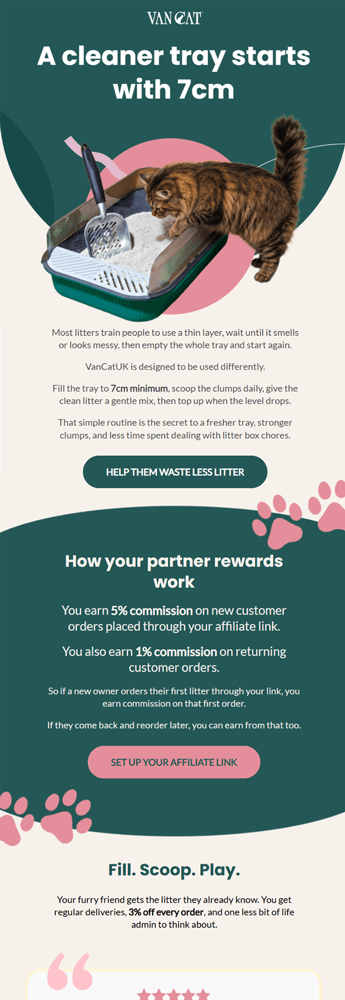
VanCat sells cat litter that works differently: it’s designed to be scooped and topped up rather than fully replaced.
So, the emails had an extra challenge: explaining why a premium litter with a higher price tag can still work out better value over time – but only when customers understand how to use it correctly.
We analysed 5,500 customer reviews and pre-purchase questions. The goal was to find the exact words customers used when they were confused, sceptical, relieved, impressed, or ready to buy.
This data was then matched up to further research into who was saying what, what they already understood, where they were in the buying process, and what they still needed to believe.
Those exact phrases went straight into the copywriting, so the emails speak to the customer in their own language.
monthly email revenue

And that’s the difference between customer-led email and generic email.
Generic email says what the brand wants to say.
Customer-led email reflects what customers already think and feel.
read our full case studiesA customer-led process tied directly to store economics
Diagnosis from real customer language
An audit of what real people are already telling you: customer reviews, post and pre-purchase surveys, and support tickets. These are mapped directly against what customers actually do on-site, where they came from, and what the numbers show in Klaviyo, Shopify, and Google Analytics.
Discovering exactly what customers are thinking at what moment, what objections are stalling conversions, and identifying behaviour-based triggers. The aim is to understand what language they use, what they care about, and where email can help.
Lifecycle strategy built on the data
Building and improving automated flows and campaigns (email, SMS and WhatsApp): including welcome sequences, sign-up forms, abandoned carts, post-purchase journeys, winbacks, replenishment cycles and more. All backed by segmentation and timing by what people have bought, browsed or ignored.
Emails are written from the customer inward, based on what the customer needs to hear to move closer to buying, or buying again. The data gives us the hypothesis. Testing shows what customers actually respond to.
Reporting with commercial context
Email marketing needs to directly support your broader business P&L and growth model.
Email numbers on their own don’t tell you much. Performance only makes sense next to traffic quality, offer strength, campaign context, revenue per recipient, repeat purchase, list health, attribution caveats – plus whatever else changed in the business that month.
A good report should help explain why something happened and what to do next.


I’m Marcus Dace
I’ve been working in ecommerce since 2012, spending most of that time close to the messy reality of online stores: margins, sourcing, ad spend, customer objections, abandoned carts, conversion, attribution. And the numbers not always telling the full story.
I started Send with Purpose in 2019. When you work with me, I do the research, strategy, setup, copywriting, reporting, and client calls myself. I also direct the creative, drawing on my background in interactive design, with the final email designs produced by a small team I have worked with for years.
Email pulls together customer psychology, offer strategy, conversion thinking, list health, deliverability, product education, and the commercial reality of how the store actually makes money.
There’s a lot going on, and that’s why I love it.
— Marcus
Good questions
Will this work for my store?
Send with Purpose is a fit for commercially serious ecommerce brands with established paid acquisition channels, enough product depth for retention to move the needle, and a team willing to share the data, context, and customer insight needed to do the work properly.
Our research process does the heavy lifting up-front, so you won’t be stuck spoon-feeding another agency the basics of your product, customer, and brand.
But will you still use my brand voice?
Do you do just strategy, or execution too?
Both. This work covers research, strategy, copywriting, design, technical setup, domain health, list health, reporting, and deployment.
But most importantly, email only makes sense when you understand what’s happening around it. The retention strategy has to sit alongside the rest of the business: paid ads, social, influencers, testimonials, website performance, and your wider marketing calendar.
How do I know email is the right lever?
Every ecommerce store grows through a combination of levers: acquisition, conversion, retention, average order value, and customer lifetime value.
Many agencies assume email is the answer because email is what they sell.
Instead, we look at your store’s economics and work out where the growth problem actually sits. In many cases, email impacts multiple growth levers at once: helping more people buy, come back, and become worth more over time.
That’s what we go through during the free 15 minute Retention Revenue Review.
Under-performing email
rarely looks urgent
book your 15 min retention revenue review Every month we were putting off sorting out email marketing was another month of missed revenue. Marcus took ownership of the entire channel and the difference was immediate, we wish we’d done this much earlier.


